Category Archives: Contemporary Classical

EXCLUSIVE: Reich, Signal, Stew, ETHEL, Muhly, DuBois and more win Meet the Composer grants

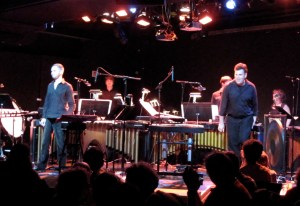
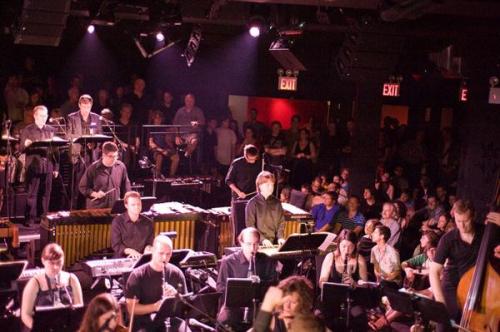
Signal performing at (Le) Poisson Rouge.

Signal performing at (Le) Poisson Rouge.

It’s an exciting morning for new music. Meet the Composer, the leading new music commissioning organization, is announcing the winners of  $450,000 in grants to composers and performers for 2009, and Will You Miss Me When I’m Gone? has the list first.

The list includes many of WYMMWIG? favorites like composers Steve Reich, David Lang, Julia Wolfe, Nico Muhly and R. Luke DuBois and performers like Signal, Talujon Percussion Quartet, ETHEL string quartet, Alarm Will Sound and So Percussion.

Awards also went to some pop and jazz projects, including Stew, the co-creator of the Broadway musical Passing Strange, and the Village Vanguard jazz club.

MTC doubled the pool of money this year as part of what it’s calling a “new music stimulus program,” awarding $300,000 to 31 composers through its Commissioning Music/USA program and a total of $150,000 to 30 NYC-based new music ensembles and presenters through Cary New Music Performance Fund.

MTC President Ed Harsh says: “At this critical moment for artists around the country, we wanted to be aggressive in multiplying the effect of Meet The Composer’s continuing programs. We are dedicated to keeping creative musicians on the job doing what they do best, which is to make music.”

The increased funding and extended deadlines this year flooded MTC with three times the usual number of applicants for composer awards.

Panelists for the first round of the composer awards were Christian Amigo, Elizabeth Brown, Conrad Cummings, Jenny Lin, Eleonor Sandresky, Steven Swartz, Theodore Wiprud, and Du Yun.  The panelists for the final round were Edmund Campion, Jeremy Geffen, Joan La Barbara, Oliver Lake, and Matt Haimovitz.

The committee that picked the performer winners was composed off Darcy James Argue, Allen Blustine, Margaret Leng Tan, and Randy Woolf.

See the full list of grantees after the jump. Continue reading
Steve Reich at MASS MoCA

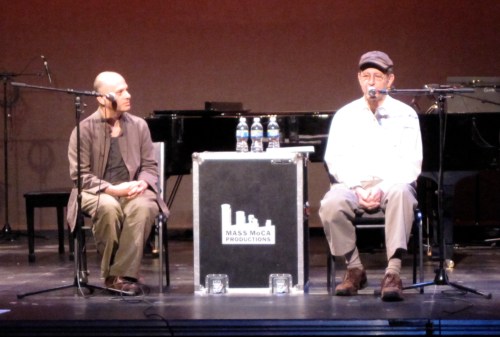
Composers David Lang and Steve Reich at MASS MoCA on Saturday, July 25. (Copyright 2009, Steven P. Marsh)

Composers David Lang and Steve Reich discuss the life and work of artist Sol Lewitt, whose wall drawings are the subject of a retrospective at MASS MoCA. (Copyright 2009, Steven P. Marsh)

Every summer for eight years running, a New England museum of contemporary art becomes a museum of contemporary sound for a couple of weeks when Bang on a Can moves in.

This year’s festival started July 14 when NYC-based Bang on a Can’s founders Michael Gordon, Julia Wolfe and David Lang, plus staff, and a crew of teachers joined  35 young musicians and composers at the Massachusetts Museum of Contemporary Art (MASS MoCA) in North Adams, Mass.

While there, the students, called fellows, spend their days working with faculty members — some of the best players, conductors and composers on the contemporary music scene today — and preparing music for two gallery recitals a day over the course of the 2 1/2 week program. It’s a musical boot camp, where the boundaries between work and play are happily blurred as participants flow from gallery recitals to concerts to informal jam sessions at working-class town taverns.

Every year, the festival also eatures a major figure from the contemporary music scene as special guest, an artist who typically interacts with the fellows and often plays with them onstage.

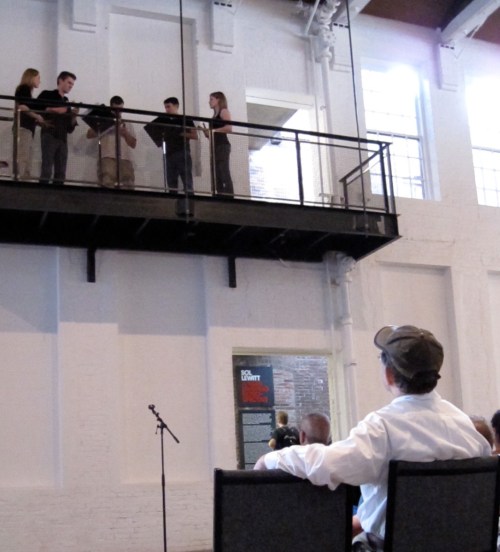
Performing Music for Pieces of Wood while the composer looks on.

Performing Music for Pieces of Wood in a gallery adjacent to the Sol Lewitt exhbit while the composer looks on.

This year’s festival is a little different. Steve Reich, a master of minimalism, who, like Meredith Monk, Don Byron, and Terry Riley, has been in a guest artists at previous Bang on a Can summer festivals, is more  featured artist. He made an appearance on Saturday, July 25, to reminisce about his friendship with the late Sol Lewitt, whose wall drawings are the subject of a massive retrospective show at the museum.

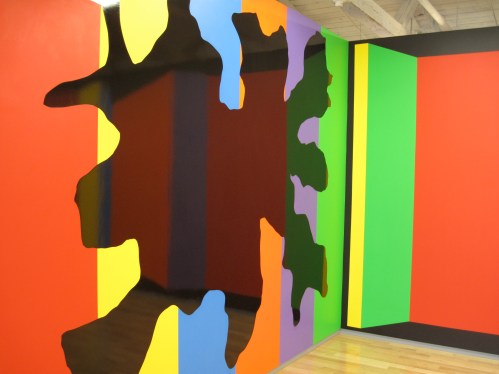
Sol Lewitt turned to bright colors in his later wall drawings, like these on the third floor of the MASS MoCA exhibit.

Sol Lewitt turned to bright colors in his later wall drawings, like these on the third floor of the MASS MoCA exhibit.

Reich was also feted with performances of his music in the gallery and the courtyard of the museum and in a more formal way with an evening concert including one of his best-known works, Music for 18 Musicians, and one of his toughest, Eight Lines.

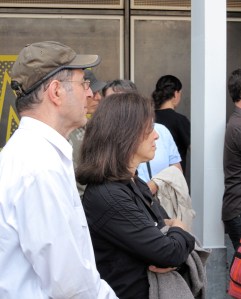
Reich and wife Beryl Korot listen to David Cossin play drums.

Reich and wife Beryl Korot listen to a percussion performance in the MASS MoCA courtyard.

It was a splendid day, with lost of spirited playing. Reich looked quite pleased with the results, and I was thrilled to see the black box theater packed for the evening performance.

Bang on a Can’s rendition of Music for 18 Musicians (which actually involved 19 musicians in this particular presentation) was played well and with emotionally satisfying results. Eight Lines, written for eight players, but performed herre in a version for 16, came together well. It was a testament to the professionalism and dedication of the players that they were able to pull together a credible performance of the difficult piece in less than two weeks.

If you haven’t checked out MASS MoCA yet, I urge you to do it. The museum is spectacular and the art changes dramatically from year to year. And Bang on a Can’s festival, dubbed Banglewood as a play on the much more conventional Tanglewood Music Festival nearby, will open your eyes and ears.

The crowning achievement of each summer’s festival is the marathon. This year’s six-hour marathon runs from 4-10 p.m. this Saturday, Aug. 1, in the Hunter Center at MASS MoCA. It will feature a host of works, including George Antheil’s Ballet Mechanique and Shaker Loops, one of John Adams‘ early works. Tickets are available by clicking here. $24.

Behind the scenes with Bang on a Can’s Asphalt Orchestra

Even though Midsummer Night Swing has only just begun its reign in Lincoln Center’s Damrosch Park, it’s not to early to start thinking about its sister program, Lincoln Center Out of Doors, which knocks down the dance floor and turns the park into a concert venue in August.

We’re just three weeks away from the debut of Asphalt Orchestra, an out-of-the-ordinary marching band created by Bang on a Can to perform world premieres of works by Stew and Heidi Rodewald of Passing Strange fame, Tyondai of Battles and Goran Bregovic, along with tunes by Icelandic pop star Bjork, Swedish experimental metal band Meshuggah, Charles Mingus, Conlon Nancarrow and Frank Zappa.

While many marching bands are heavily choreographed, I’m guessing no other band will be under the dance direction of modern dance choreographer Susan Marshall.

Asphalt has already started rehearsing. And here, thanks to Time Out New York, is a behind-the-scenes video about the group.

Vodpod videos no longer available.

Signal rocks Reich

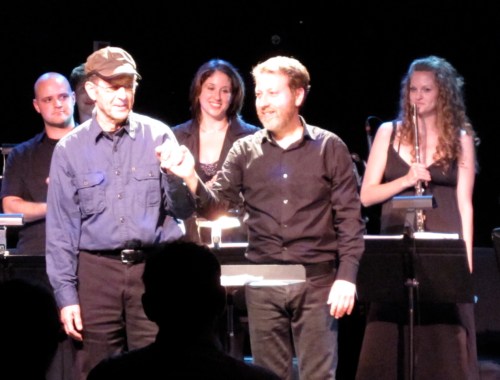
Composer Steve Reich and conductor Brad Lubman take their bows. (Copyright 2009, Steven P. Marsh)

Composer Steve Reich and conductor Brad Lubman take their bows. (Copyright 2009, Steven P. Marsh)

Signal, one of the nation’s premiere New Music ensembles, celebrated composer Steve Reich‘s 2009 Pulitzer Prize for Music on Monday night with a special performance of Double Sextet, the composition for which he won.

Signal managed to sell out (Le) Poisson Rouge on Bleecker Street in Manhattan’s Greenwich Village so quickly that a late show was added, and that one appeared to be nearly sold out by the time it started.

The show opened with a rendition of Reich’s Sextet, an older piece. The crowd at the late show seemed to appreciate the performance by just six of Signal’s talented members, but most were really there to hear Double Sextet, which before Monday had performed only once in NYC, at Carnegie Hall by eighth blackbird, the Chicago-based ensemble that commissioned the work.Steve Signal performing

While the premiere performances featured six musicians playing against a tape of themselves playing the second sextet parts, Signal chose to play both sextets live, with 12 musicians onstage — two sextets consisting of flute, clarinet, violin, cello, vibraphone and piano. (Steve intended the piece to be played either way.)

I enjoyed eighth blackbird’s NYC premiere of the piece last year, but Signal’s rendition brought out nuances and beauty in the piece that I missed the first time. Steve plays with dynamics and tempos in the piece, and even seems to dip into a bit of phasing, a technique that he frequently employed earlier in his career in which identical lines fall out of sync with one another, creating a kind of counterpoint.

Six of Signal's musicians performed Sextet, the 1985 predecessor to Reich's Pulitzer-winning composition.

Six of Signal's musicians performed Sextet, the 1985 predecessor to Reich's Pulitzer-winning composition.

It was a revelatory performance by an amazingly skillful ensemble, led by conductor Brad Lubman. Steve clearly gave his imprimatur to the performances, attending both shows and taking an emotional bow at the conclusion of it.

Scenes from a marathon

Ethel String Quartet and Lionheart performing the otherworldly "John the Revelator" by Phil Kline. (All photos by SPM except as noted. All rights reserved.)

Ethel String Quartet and Lionheart performing the otherworldly John the Revelator by Phil Kline. (All photos by SPM except as noted. All rights reserved.)

Ryuichi plays with reflections as he takes the podium to lead the Bang on a Can All-Stars. (Photo by CMM)

Ryuichi Sakamoto plays with reflections as he takes the podium to lead the Bang on a Can All-Stars. (Photo by Christine Maurus)

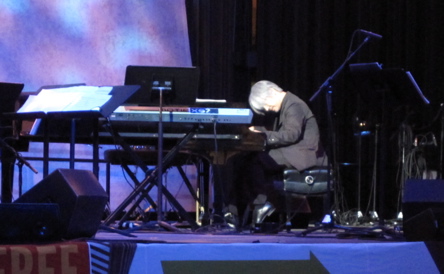
Sakamoto at the piano, performing an untitled solo piece.

Sakamoto at the piano, performing an untitled solo piece.

The Bang on a Can Marathon, held at the World Financial Center’s Winter Garden in Battery Park City on Sunday was an amazing 12-plus hours of music, leaning more toward the classical side this year.

More photos after the jump. Continue reading
More from Bang on a Can

Bang on a Can, the group that brought you Sunday’s 12-plus-hour orgy of free music at the World Financial Center’s Winter Garden on Sunday, is really pouring it on this week.

On Wednesday, BoaC is looking to make a little money to fund its future and to help keep the marathon free, with a $400-a-person benefit dinner, complete with some great performances, at Le Poisson Rouge at 158 Bleecker Street in Greenwich Village. Performers at this big-ticket event include Meredith Monk, Steve Reich (with Bang on a Can All-Stars’ percussionist, David Cossin), pipa master Wu Man, cellist Maya Beiser, percussion quartet Talujon, and video artist Doug Aitken.

And, showing its wry sense of humor, Bang on a Can has created a second, far more affordable way to support its worthy endeavors: The Bang on a Can’t Afford the Other Benefit, which will set you back just $20. It’s also at LPR, following the benefit dinner at 9:30 pm. And just because the pricetag is much, much lower doesn’t mean the players will be any less illustrious. The list includes: So Percussion , Gutbucket , Newspeak (with violinist Todd Reynolds as featured guest, sitting in for Caleb Burhans) and NOW Ensemble.

So, if you can afford the $400 benefit, come on down — and stay for the afterparty.

If you can’t afford that, then shell out $20 for the great afterparty.

Either way, you’ll be aiding the noble cause of new music in New York.

Twitter taking the fore at the the Bang on a Can Marathon (Updated)

UPDATE: Here’s the lineup of members of the Bang on a Can Marathon Tweet Team (#bangonacan) this Sunday. Please check us out: @anastasiat @talkmusic @sethcolterwalls @espyem @ogiovetti @memilybk @cryfok @elimaniscalco and the father-and-son team of @dotdotdottweet and @forcetengale

—-

Whether you can get to the World Financial Center’s Winter Garden on Sunday or not, stay tuned to Twitter for the event’s first-ever organized Tweet Team. Sure, people have done live blogging from the multi-act and multi-hour musical event. But this year Twitter rules!

I’m proud to be one of the Twitterers who will be weighing in on this wonderful musical event. Christina Jensen, who organized the Tweet Team for the 12-hour marathon, says:

The BOAC Tweet team will be at the Marathon at various times over the 12 hours, tweeting their impressions of the music & people.about 5 hours ago from web

Christina Jensen PR

Please follow us on Sunday and join in the fun with your impressions in response to ours!

ACME to play with Grizzly Bear at Town Hall

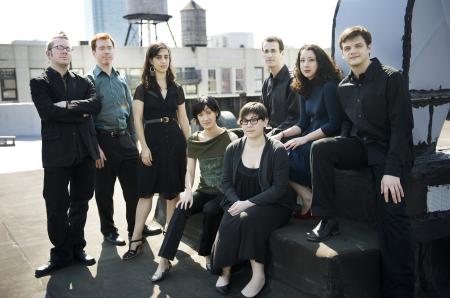
ACME Ensemble

ACME Ensemble

ACME (American Contemporary Music Ensemble) will be playing with Grizzly Bear on Thursday and Friday at NYC’s Town Hall, the indie New Music band’s Executive Director Christina Jensen announced via her Twitter account last night:

Loader

If you have tickets for either of these shows (both are sold out), you’ll find that ACME will fit perfectly into the vibe, as the ensemble, which played the string parts on Grizzly Bear’s latest album, Veckatimest (released today — get your copy now!), shares genre-bending proclivities with Grizzly Bear and their opener, Here We Go Magic.

ACME is no stranger to the rock stage, having been involved in Ronen Givony‘s Wordless Music, which pairs rock bands and classical ensembles on the same bill, with great frequency. The core members of ACME, which has been around since 2004, include violinists Miranda Cuckson and Caleb Burhans, violist Nadia Sirota, cellist and artistic director Clarice Jensen, flutist Alex Sopp, clarinetist Gilad Harel, pianist Eric Huebner, and percussionist Christopher Thompson.

Signal brings Glass’ Symphony No. 3 to life

lubman

Signal conductor Brad Lubman

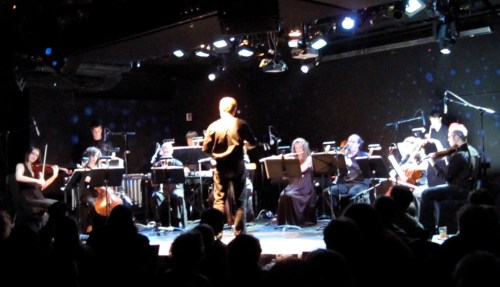
Signal, the superb New Music ensemble, gave a remarkable reading of Philip GlassSymphony No. 3 at Le Poisson Rouge in Greenwich Village last night.

The intimate club setting, with seating the round, really enhanced the mood. And Signal, under the direction of Brad Lubman, played the symphony crisply and with conviction. Although I’ve heard it played before, Signal’s playing made me appreciate it in ways I’ve never been able to do before. It’s emotional and pushes buttons in ways that sometimes seem overly manipulative. But Signal brought out the symphony’s true beauty. Signal’s rendition seemed to strip away those distractions, leaving the core beauty of the symphony. And the violinists who traded off the solo lines in the third movement — especially lead-off player Courtney Orlando — provided a potent reminder of just how skillfully and beautifully Glass writes for that instrument.

The symphony has a cinematic quality that was emphasized by its pairing on last night’s bill with Suite from The Hours, which actually is movie music. Michael Riesman, a pianist and the conductor of Glass’ ensemble, played the Suite like he was born to it — probably because he arranged the three-movement work using from Glass’ music from The Hours, the 2002 Stephen Daldry film.

It’s worth noting that the house was packed for Signal’s performance. All all the tables seemed filled and fans stood three deep at the bar. The composer himself graced the elevated VIP box with his girlfriend, the talented cellist Wendy Sutter, at his side.

Worth discovering: Nadia Sirota

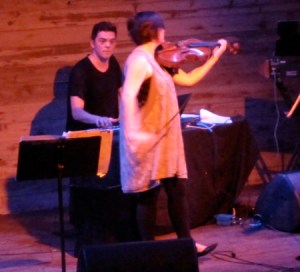
Nadia Sirota (right) and Clarice Jensen performing Nico Muhly's  "Duet No. 1, Chorale Pointing Downwards" at Galapagos Art Space.

Nadia Sirota (right) and Clarice Jensen performing Nico Muhly's "Duet No. 1, Chorale Pointing Downwards" at Galapagos Art Space.

I regret missing the first of the four installments of Undiscovered Islands, the festival of new music presented on Friday nights in May at Galapagos Art Space in Dumbo, Brooklyn, by New Amsterdam Records. By all acconts, Darcy James Argue’s Secret Society — an 18-piece ensemble that Argue has dubbed a “steampunk big band” —  put on a killer show. (I still haven’t figured out how to be in two places at once, and MONO and the Wordless Music Orchestra were already on my calendar for that night!)

Nico Muhly and Nadia Sirota.

Nico Muhly and Nadia Sirota.

I’m glad I didn’t miss the second installment last night. It was a CD-release party for violist Nadia Sirota‘s first solo CD, First Things First. The program, credited as Nadia Sirota and friends, included many of the pieces on the new album. But her friends, including Caleb Burhans and Grey McMurry of itsnotyouitsme, cellist Clarice Jensen, and the Chiara String Quartet, did their own works as well. Continue reading